
Packaging Inspection: 5 Things to Include on Your Quality Checklist



Table of Contents
When your carton fails the drop test during a pre-shipment inspection, the rework can set you back a few days or even a week. However, it’s a good thing you caught the issue, because if the carton had failed during transit, you would have had to scrap some or all of your product.
When clients come to us with their initial inspection checklists, they might spend three pages talking about how to check the product but treat packaging as an afterthought, with a single line that says: “check packaging condition.”
Packaging deserves a lot more consideration than that, though. It can be made up of three to five distinct layers. Each one needs to be considered separately, and a failure in one can cause the product to fail.
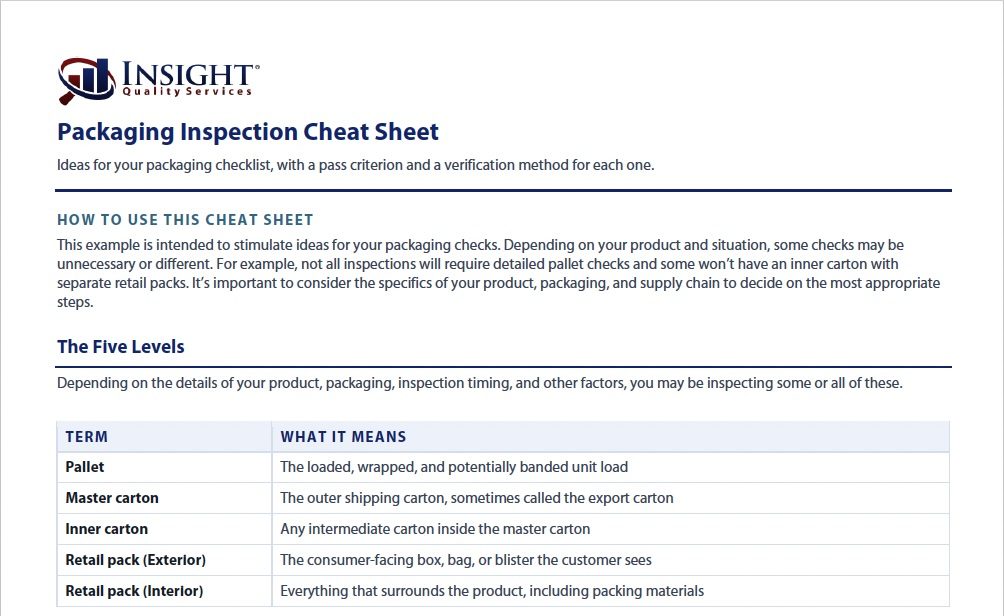
Before you continue… Download our packaging inspection cheat sheet with 40+ inspection point ideas to accompany this article.
A perfect retail box inside a crushed master carton is no longer a perfect retail box. And a master carton with a barcode that won’t scan creates a major roadblock at your retailer’s receiving door.
Here, we discuss five levels of packaging checks that your quality checklist might cover, starting from the outermost level and moving to the innermost. Use this guide as a reference when you’re thinking about what types of packaging checks are appropriate for your product.
#1 Pallet Checks
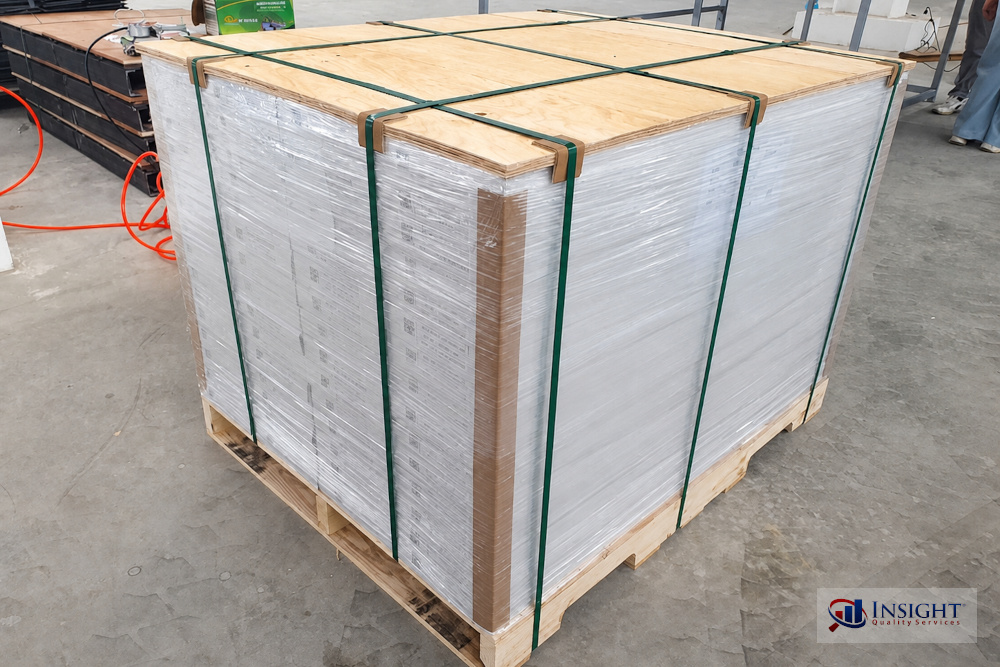
Not every importer needs to be overly concerned about pallet checks. However, if you’re dealing with the strict warehouse requirements of a big-box retailer, have goods that are more sensitive to moisture and impact damage, or use specific loading plans to maximize container space, it makes sense to look at your pallet more carefully.
The pallet is a structural component. Its job is to hold your cartons in a stable block through forklift handling, container loading, and warehouse racking.
The most basic pallet checks include:
- Load Dimensions. Measuring a few pallets to ensure they have the correct length, width, and height.
- Label Check. Verifying the shipment information on the pallet label is correct, legible, and positioned correctly.
Sometimes our clients have more detailed requirements or are conducting a loading inspection where thorough pallet checks are important.
More detailed pallet checks can include:
- Load pattern. Correct number of layers, correct number of cartons per layer, correct total height, counted against the pallet specification.
- Overhang or Coverage. Ensure cartons do not overhang past the wooden pallet edge or that a certain percentage of the pallet is covered (e.g., 97% coverage).
- Banding and film. Straps do not move laterally when pushed firmly by hand, and shrink film anchors the top layer to the pallet deck, not just wrapping the sides.
- Edge and corner protection. Cardboard protectors are seated flush under the straps, with no gaps and no crushing.
- Pallet specification. Pallet type, size, and material match the written spec
- Pallet condition. No broken boards, protruding nails, splinters, mold, or visible moisture.
- Load stability. Load does not shift or lean when the pallet is moved.
- IPPC marking on wood pallets. Wood pallets carry a legible IPPC stamp, HT code, and country.
Now that we’ve talked about the pallet, let’s get into what’s sitting on top of it.
#2 Master Carton Checks

The master carton is sometimes overlooked because it’s not consumer-facing. However, if your master carton is not strong enough to protect the packaging and goods inside it, it leads to damage that can make your product unsaleable.
A factory under cost pressure might swap to a thinner corrugate or a lower-grade liner. The carton would look identical to the untrained eye, but you’d only find out once the container arrives with crushed cartons in the bottom two layers.
Having the correct marks on your cartons is also essential to ensure correct routing, customs clearance, and appropriate handling.
Here are some of the most common carton checks:
- Shipping marks. Every required field is present, legible, and matches your purchase order (PO), including: The PO number, SKU, carton number, net weight, gross weight, country of manufacture, etc.
- Handling marks. Fragile, this-side-up, humidity, stacking-limit, or any other required handling marks are present and correctly oriented.
- Carton surface. There are no dents, crushed corners, cracks, water staining, or scuffs.
- Closure and sealing. Specified tape, glue, staples, or bands are used and applied in the correct pattern.
- Dimensions. Length, width, and height of the carton are within specification tolerance.
- Contents and assortment. Correct count inside, and for mixed-SKU cartons, the correct ratio.
Other things you might check:
- Odor. Before the air clears, the inspector checks for solvent, mildew, chemical or other unusual smells.
- Packaging accessories. Desiccants, humidity cards, void fill, and dividers are present in the specified quantity and position.
- Board grade and construction. The inspector compares the flute profile and liner against your signed sample.
- Burst or edge crush rating. Check the box maker’s certificate printed on the carton against your specification.
We’ve talked about the master carton; now let’s look at what to check inside it.
#3 Inner Carton Checks
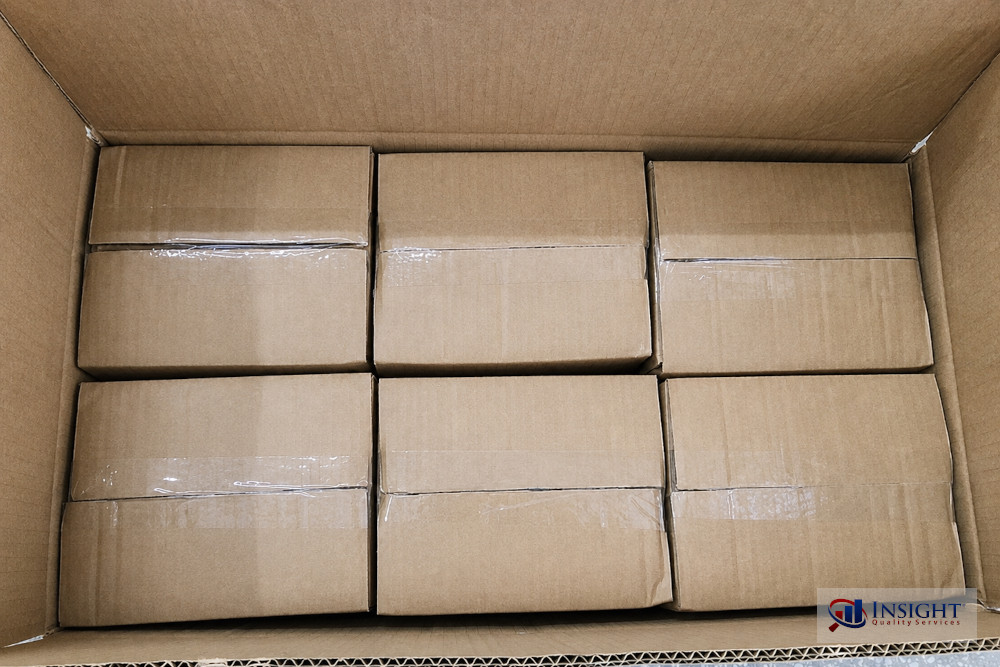
Not every product has an inner carton, so if your retail packs go straight into the master carton, you can skip to the next section. However, if you use an intermediate layer, it needs its own checks, because it’s carrying load that neither the master carton nor the retail pack was designed to carry.
The checks that matter most:
- Condition after removal. No crushing, tears, or staining once the inner carton comes out of the master carton.
- Fit inside the master carton. Snug, with no lateral movement.
- Count. Correct number of retail packs per inner carton.
- Print or label. Content matches the spec, print is legible, and label is positioned correctly.
- Barcode. Scans on the first pass, and the result matches both the printed number and your purchase order.
Inside the master carton or inner carton, you’ll find your retail packs.
#4 Retail Pack Checks (Exterior)

The retail pack is the only packaging the end consumer will ever see, and the retailer you’re shipping to will definitely judge you on it.
Master cartons are about protecting their contents and getting the product to where it needs to be. However, retail packs not only need to be strong, but they also need to be identical. Ten packs from ten different cartons need to look like they came off the same press.
Here are the most common checks:
- Color against approved artwork. Match your signed sample and Pantone references side by side under consistent lighting.
- Print quality. Text and logos sharp and correctly positioned. No blurring, color smear, misalignment, or ghosting.
- Surface finish. No visible scratches, stains, bubbles, or scuffing when viewed from a specified distance, such as 40-60 cm.
- Shelf consistency. Packs pulled from different cartons have no visible differences.
- Barcode. Every barcode type on the pack scans on the first pass. Nothing printed across a fold, creased, or crowding the edge.
We’ve talked about the outside of the retail packs, but don’t forget to check the packaging elements on the inside.
#5 Retail Pack Checks (Interior)

The last layer is everything that touches the product itself, from the packing materials to inserts and accessories.
Some checks to consider:
- Packing materials present. Every item in your packing SOP, including foam, bubble bags, paperboard, and inserts.
- Compliance features present. Any packing materials, such as poly bags, that require features like warning text or venting holes have them.
- Cushioning fit. When shaking the pack by hand, the cushioning prevents the product from moving.
- Product orientation. The unit sits in the specified position inside the pack.
- Inserts and accessories. Manuals, warranty cards, cables, and hardware are present and correctly placed.
- Label and ticket placement. Labels, hangtags, and price tickets are in the specified position and orientation.
Don’t Forget the Drop Test
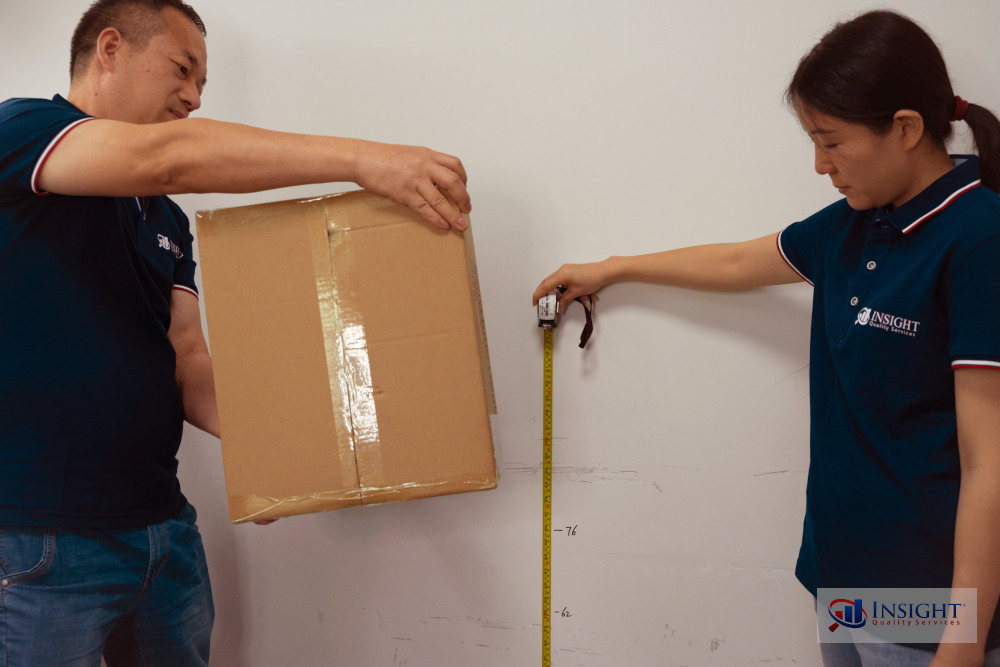
Along with the checks above, we often recommend a carton drop test during inspection to ensure your packaging actually performs as expected and is strong enough to withstand the shipping journey.
Under the ISTA 1A sequence, the inspector drops the master carton ten times: the most fragile corner, three edges, and six faces. Drop height is set by weight, from 30 inches for cartons under 21 lb down to 8 inches for loads between 100 and 150 lb.
A pass means no damage to the master carton or the packages inside, no scratches or dents on the product, and a product that still functions.
Do You Need Someone on the Ground?

Packaging problems are cheapest to fix while the goods are still at the factory. Once a container leaves, your options narrow fast, and reworking product in your market country gets expensive.
Insight offers product and packaging inspection services in more than 30 countries. Whether you’re checking a new supplier’s first production run or inspecting at a factory you’ve used for years, you need eyes on the factory floor before the goods ship.
Talk to us about your inspection needs →
We also recommend downloading our handy packaging checklist reference to accompany this article.
Note: This article was originally posted in July of 2020 and updated in September of 2026.
AQL Inspections 101: How They are Conducted
Authors
4 comments
Sam Evans
Thank you so much for publishing such a beautiful article which I have learned a lot from watching. From here I have learned how to control the packaging quality. You have explained it very nicely. Your article is very informative. Thank you very much.
Insight Team
Thank you for your kind words, Sam.
Delia Porras
Hello, Thank you for your article. To perform in-process verification during a packaging process of bottles ( supplements), do I have to check 1 to 3 bottles each 15 minutes in each station ( filling, capping desiccant outer, label), or do I have to take the 3 samples each 15 minutes at the end of the line and then remove the outer seal, the cap, the neckband, for checking the count, desiccant, etc.) I’m losing components ( caps); what is the correct way to perform this sampling, during the line or at the end?
Thank you
Insight Team
Inspection procedures can be customized to address specific issues as in your case. For example, if count is consistently found to vary then conducting a count and verifying the number of capsules could be conducted after filling and before capped and sealed. This would be more efficient and reduce packaging waste. Conducting an inspection at the end of the production process would allow the inspection of all the various elements and not sure verification of the count.
Comments are closed.